Google AI Shopping: What It Means for Ecommerce Stores in 2026

Synmentis
Google Shopping used to be pretty straightforward.
Someone searches for a product.
Google shows products.
The shopper compares them.
They click.
They visit the store.
Then they decide whether to buy.
AI is changing where the comparison happens.
Someone can now ask Google a much more specific question:
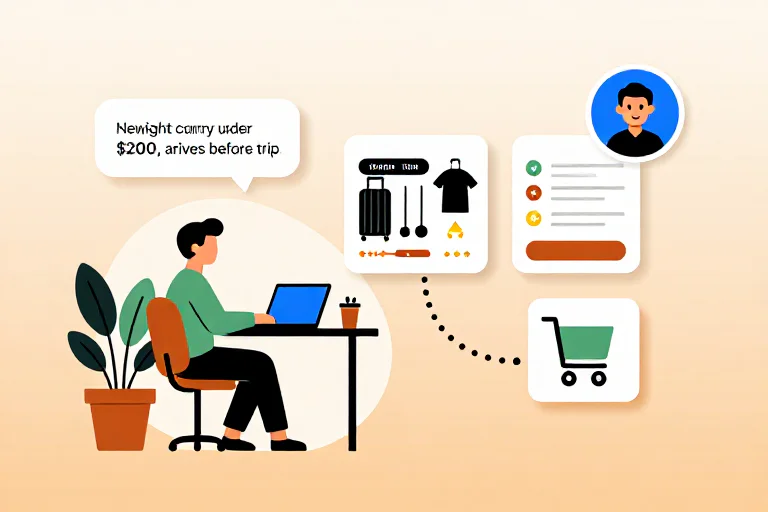
"I need a carry-on suitcase under $200 that is lightweight, has a good warranty, and can arrive before my trip."
That's not really a traditional product search anymore.
The shopper isn't simply looking for a product.
They're asking Google to help solve a shopping problem.
And Google is building more of the shopping experience around that.
In May 2026, Google introduced Universal Cart and additional agentic shopping capabilities across Search and Gemini. In September 2026, Google also made its AI Performance Insights generally available in eligible markets so merchants can see how their products are discovered across AI-driven shopping experiences.
So the question for ecommerce stores is no longer just:
"How do I show up in Google Shopping?"
It's increasingly:
"How does Google understand my products when someone asks an AI to help them shop?"
Google AI Shopping is different from traditional Google Shopping
Traditional product search is largely built around a query and a set of matching products.
For example:
"women's running shoes"
The shopper gets products.
They can filter.
They can compare.
They click.
AI shopping can start with something much more conversational:
"I'm training for my first half marathon. I have wider feet, usually run on roads, and I'd like to stay under $150. Which shoes should I look at?"
Now the system has to understand several things at once:
- activity
- experience level
- foot shape
- surface
- budget
- product category
The result isn't simply:
Which products contain these words?
It becomes:
Which products best match this person's situation?
Google's current AI Performance Insights specifically reflects this shift toward more complex, conversational shopping queries. Google says the report can show merchants the product terms, attributes, search intents, and shopping stages associated with AI shopping journeys.
That's a meaningful change for ecommerce.
Your product is being evaluated against a shopper's situation
This is probably the most important thing to understand.
Imagine you sell three office chairs.
Chair A
$180
Compact
Basic adjustment
Chair B
$320
More lumbar adjustment
Higher weight capacity
Better for long sessions
Chair C
$600
Large
Premium materials
Highly adjustable
Traditionally, you might optimize all three around variations of:
office chair
But a shopper doesn't really want "an office chair."
They want:
the right office chair for me.
Someone with a small apartment may prefer Chair A.
Someone who works eight hours a day may prefer Chair B.
Someone who cares about premium materials and maximum adjustment may prefer Chair C.
Google AI Shopping increasingly has to reason about those differences.
That means your product information needs to explain more than what the product is.
It needs to make the reason for choosing it understandable.
This is where product data suddenly matters much more
If Google is trying to compare products, it needs usable product information.
Price.
Availability.
Attributes.
Variants.
Shipping.
Returns.
Reviews.
Product category.
And other details that help determine whether a product matches the shopper's request.
Google's AI Performance Insights now explicitly surfaces popular product attributes and lets merchants see where their products may be missing information used in AI-driven shopping journeys.
That's interesting because this isn't just an SEO report.
It's telling merchants something about how people are shopping through AI.
For example, suppose shoppers frequently ask about:
material
but your product feed barely contains material information.
Or shoppers repeatedly ask about:
size
but your product attributes don't clearly describe it.
Now you have something concrete to investigate.
AI shopping makes vague product descriptions more of a problem
Consider these two descriptions.
Product A
Premium travel backpack designed for modern travelers.
Product B
28L carry-on backpack with a separate laptop compartment, luggage sleeve, water-resistant exterior, and dimensions designed to fit under most airline seats.
The first sounds like marketing.
The second gives you information.
A human can use it.
An AI can use it.
If someone asks:
"I need a backpack for a three-day business trip that I can use as a personal item."
The second product gives the system much more to work with.
This is why I wouldn't think about Google AI Shopping as another keyword game.
It's much closer to:
Can the system understand the product well enough to decide whether it fits the request?
Don't write product pages for Google AI
This is where people are likely to overreact.
They'll hear about AI shopping and start rewriting every product page to sound like an AI prompt.
I don't think that's useful.
You don't need sentences like:
"This product is ideal for consumers searching for premium carry-on luggage for business travel."
That sounds unnatural.
Instead, give the product page real information:
Who is it for?
What does it do?
What are its important attributes?
What does it cost?
What are its limitations?
What makes it different?
When is it a good choice?
When is it not?
That's good ecommerce information.
AI benefits from it because there is more to understand.
Humans benefit from it because there is less to guess.
The interesting part is the comparison
Google doesn't need to find one product.
It can compare options.
That's where the experience gets more interesting for merchants.
Imagine the shopper asks:
"What's a good carry-on for frequent international travel under $250?"
Your product might be $220.
A competitor is $190.
Another is $245.
Now price isn't enough.
The system may also consider:
weight
dimensions
warranty
reviews
availability
delivery
materials
capacity
The product that gets shown isn't necessarily the cheapest.
It's the one that makes sense against the shopper's requirements.
So your product page needs to make those differences easy to understand.
Your strongest selling point may be invisible to AI
This is a very real problem.
Imagine you sell a premium mattress.
You know that your biggest advantage is:
better for people who sleep hot.
But your website mostly talks about:
premium materials
luxury comfort
innovative design
exceptional craftsmanship
Those are broad marketing claims.
Now a shopper asks:
"Which mattress is best for someone who sleeps hot?"
Your actual advantage may not be obvious enough.
A competitor with a very clear:
"Cooling mattress for hot sleepers"
positioning could be easier for an AI system to understand.
Even if your product is genuinely better.
That's the distinction between having a differentiator and communicating a differentiator.
Product attributes are becoming decision attributes
This is a useful way to think about product data.
Don't just ask:
"What attributes does this product have?"
Ask:
"Which attributes actually determine whether someone chooses it?"
For running shoes:
cushioning
width
terrain
drop
weight
For luggage:
weight
capacity
dimensions
warranty
For furniture:
dimensions
material
assembly
weight capacity
delivery
For skincare:
skin type
active ingredients
sensitivity
use frequency
Different products have different decision attributes.
The important ones are the ones that shoppers actually use to compare.
Google is starting to show merchants what those attributes are
This is one of the more useful developments in Google AI Shopping.
Google's AI Performance Insights includes product-term and product-attribute insights. The report can show popular product specifications used in AI shopping journeys and identify products with missing structured attributes.
That means merchants don't necessarily have to guess what information matters.
At least in eligible Google AI shopping data, they can start looking at what shoppers are actually asking about.
That is much more interesting than another generic SEO keyword report.
The shopping journey is becoming more conversational
This is another important change.
Traditional search might look like:
"best running shoes wide feet"
A conversational shopping request can become:
"I'm looking for running shoes for wide feet, but I don't run very fast and most shoes feel too stiff. I usually run about 5km three times a week. I'd rather spend under $130."
There is a lot more information in that request.
And there is also more intent.
The shopper is effectively telling the AI:
"Here is how I make this decision."
Google's AI Performance Insights now divides AI shopping journeys into stages including Discovery, Evaluation, and Ready to buy, which reflects the fact that shoppers can use conversational AI across different parts of the buying process.
That is useful for merchants because a product can be visible at one stage and invisible at another.
Being visible during discovery isn't the same as being chosen
Imagine your brand appears when someone asks:
"What kinds of standing desks should I consider?"
Great.
But then the shopper asks:
"Which one is best for a small apartment?"
Your product disappears.
Then:
"Which one has the best warranty?"
It disappears again.
Now you have an interesting problem.
Your product is visible.
But it may not be relevant enough to the specific decision.
This is why I don't think AI visibility should be measured only as:
"Did my brand appear?"
A more useful question is:
"For which shopping questions does my product appear, and which questions does it lose?"
Google's current AI reporting is moving in this direction by showing visibility across shopping stages, query types, and product attributes rather than treating all AI exposure as one number.
The product page still matters after Google recommends you
This is easy to forget.
Suppose Google recommends your product.
The shopper clicks.
Now they're on your website.
They still need to decide.
And suddenly the old ecommerce problems come back.
Can I trust this?
Is this really what I want?
How big is it?
When will it arrive?
Can I return it?
Why is it more expensive?
What's actually different from the other version?
That means AI Shopping doesn't replace conversion optimization.
It makes the connection between discovery and conversion more important.
This is why our work on ecommerce product page optimization, ecommerce trust signals, and ecommerce conversion rate optimization still matters in an AI shopping world.
AI can bring the shopper to the right page.
The page still has to help them decide.
There is another problem: the AI can get it wrong
This is something merchants should watch carefully.
Suppose the AI thinks:
Product A is good for small spaces.
But the actual dimensions make it too large.
Or the AI thinks:
Product B arrives this week.
But the shipping information is outdated.
Or it believes two products are nearly identical because your product data doesn't explain a key difference.
Now the issue isn't visibility.
It's misunderstanding.
This is why accurate product data matters more than simply having lots of product data.
Incorrect information isn't helpful just because it's structured.
Keep the product page and merchant data aligned
Imagine:
Product page:
$249
Merchant data:
$229
Or:
Product page:
In stock
Merchant feed:
Out of stock
Or:
Product page:
30-day free returns
Returns information:
Buyer pays return shipping
These inconsistencies can create problems long before the shopper reaches checkout.
Google's broader ecommerce documentation already emphasizes accurate product data across search and shopping surfaces, and its current AI shopping work makes the need for consistency even more obvious.
The AI needs a reliable version of the product.
So does the shopper.
Google AI Shopping doesn't mean you can forget traditional SEO
This is another overreaction I would avoid.
Your ecommerce site still needs to be crawlable.
Product pages still need clear information.
Internal links still matter.
Structured product information still matters.
Google still uses ordinary Search, Images, Shopping, Lens, and other surfaces to distribute ecommerce information.
AI shopping is becoming another layer.
Not a complete replacement.
That's actually good news.
You don't need two completely separate websites:
one for Google
one for AI
You need a product experience that is clear enough for both.
What should an ecommerce store do right now?
I wouldn't start by rebuilding the site.
Start with your important products.
Take ten or twenty products that matter commercially.
Then ask:
Can I describe each product clearly?
Not the brand story.
The actual product.
Are the important attributes explicit?
Don't make the AI or shopper infer them.
Does the product page explain who it is for?
"Premium" isn't a customer.
"Good for small apartments" is useful.
Does it explain the tradeoff?
Why buy this instead of the cheaper option?
Are price and availability accurate?
And consistent wherever the product is represented.
Are shipping and returns clear?
Especially when they can change the buying decision.
Are reviews helping answer purchase questions?
Not just displaying a star average.
Can an AI understand the product without guessing?
This is the new question I'd add to the normal ecommerce checklist.
Then ask a more interesting question
Don't only ask:
"Can Google find my product?"
Ask:
"If I give Google a realistic shopper, would my product make sense for that shopper?"
For example:
"I have a very small bedroom. I need a desk under $400 that doesn't look like office furniture."
Would your product be a good match?
Could the system understand why?
Now change the shopper:
"I work from home eight hours a day. I care much more about stability and ergonomics than appearance."
Would the same product still be recommended?
Maybe.
Maybe not.
And that's okay.
The interesting part is understanding why.
This is where AI shopping becomes shopper research
This is the part I'm much more interested in.
You can use AI not only as a new channel where shoppers find your products.
You can use it as a way to research the buying decision itself.
Give different AI shoppers different situations.
Let them research.
Let them compare.
Let them browse your website.
Watch what they understand.
Watch what they question.
Watch what they ignore.
Watch what makes them choose another product.
Now you can ask:
Why wasn't this product good enough for this shopper?
Maybe the product actually wasn't a fit.
Maybe the competitor was genuinely better.
Maybe the product information was incomplete.
Maybe your website created doubt.
Maybe the AI simply couldn't verify an important advantage.
Those are completely different findings.
The future isn't "optimize for Google AI"
That's too narrow.
The more useful goal is:
Make your products understandable wherever people—or AI—go shopping.
Google is one channel.
ChatGPT is another.
Gemini is another.
Other shopping assistants will emerge.
The interfaces will change.
The underlying problem remains.
A shopper has a need.
They have constraints.
They compare options.
They have doubts.
They choose.
The better your product information supports that decision, the more resilient your store becomes across different shopping interfaces.
Google AI Shopping makes one old ecommerce problem much more visible
Merchants have always had a problem with:
"I know why my product is good. Why don't customers see it?"
AI doesn't remove that problem.
It exposes it.
Because now there is another system trying to understand the product.
If your strongest selling point is obvious to you but buried from everyone else, the AI may miss it.
If your product has a useful tradeoff but you never explain it, the AI may miss it.
If customers repeatedly care about an attribute and you don't provide it, the AI may not have enough evidence.
And if the product page creates doubt after the AI sends the shopper there, you can lose the sale anyway.
That's why I think Google AI Shopping is much less about "AI SEO" than people make it sound.
It's about making the buying decision understandable.
What I would watch over the next year
I wouldn't obsess over every new Google AI feature.
The interface will change.
The reports will change.
The protocols will change.
What I'd watch instead is:
Which shopping questions bring people to my products?
Which attributes decide whether I'm considered?
Where do I lose visibility?
What information does AI repeatedly need?
What happens after the shopper reaches my site?
And eventually:
Why did one shopper choose my product while another chose a competitor?
Those questions are much more durable than any single Google Shopping feature.
Google AI Shopping is still shopping
That's the part worth remembering.
The interface is becoming more conversational.
The research is becoming more automated.
The comparison can happen inside AI.
The cart can increasingly move across shopping environments.
But people still need things.
They still have budgets.
They still have preferences.
They still worry about making a bad purchase.
And they still need enough evidence to say:
"This one makes sense for me."
Google AI Shopping changes how that decision begins.
It doesn't remove the decision itself.
For ecommerce stores, that means the old fundamentals are not going away.
Clear products.
Useful evidence.
Accurate information.
Good comparison context.
Trust.
A buying experience that doesn't create unnecessary hesitation.
The difference is that now an AI may be helping the shopper evaluate all of it before they ever open your website.
And that makes understanding your shopper more important, not less.
Related research
- AI Shopping Is Changing Ecommerce: What Your Store Needs to Understand
- What Is Agentic Commerce? A Practical Guide for Ecommerce Stores
- How to Optimize Product Pages for AI Visibility Without Writing for Robots
- Ecommerce Product Page SEO: How to Get Product Pages Found Without Ruining Conversion
- Ecommerce Conversion Rate Optimization: A Better Starting Point Than A/B Testing